Bebiana Rocha
D’Heritage: A 50-Year-Old House That Now Signs What It Makes
For more than five decades, the Gonçalves family has made garment manufacturing its trade. Now, that expertise is taking on a new expression with D’Heritage, a brand created this year by Diogo Gonçalves, the founder’s grandson, and developed together with his father, José Henrique Gonçalves. With shirting at its core, the new brand is focused on a premium range, produced in Portugal, and is finally taking on an identity that, for years, remained behind the scenes of production for third-party brands.
“For decades, garments carrying other brands’ labels left our doors in Vila de Cucujães. Never ours.” Diogo Gonçalves’ words sum up the transformation of an industrial story that now has a signature of its own.
More than starting from scratch, D’Heritage was created with the intention of keeping a family tradition alive, bringing to the brand the knowledge and high standards built over three generations. “What we inherited is the standard, not a catalogue,” he explains in an interview with T Jornal. That standard guides the choice of materials, the construction of the garments and a production process that remains in Vila de Cucujães, allowing every stage to be closely monitored.
The ambition is to progressively build an essential and complete wardrobe, without expanding the range simply for the sake of growth. For next winter, the brand is preparing heavier-weight cotton shirting and is exploring its first outerwear piece, while in the medium term it aims to establish a physical distribution network through multi-brand stores. Internationalisation, considered from day one, will come in a second phase of growth, with Spain as the first international market in its sights.
D’Heritage comes from a family history linked to garment manufacturing since the 1970s. What does it mean to transform that legacy into a new brand, with its own identity and adapted to today’s market?
D’Heritage is not, strictly speaking, a new brand. It is a company with more than fifty years of history that has started putting its name to what it makes.
For decades, garments carrying other brands’ labels left our doors in Vila de Cucujães. Never ours. What changed was not the know-how, which already existed. It was the decision to put our name to what we make, with all the responsibility that entails.
Turning that knowledge into a brand with its own identity required us to understand that continuing a history does not mean repeating the past. What we inherited is the standard, not a catalogue. We have updated the machinery, but in some cases we have kept the same hands. What we make today is designed for the person who will wear the garment, rather than simply to meet a client’s specifications.
The family business once employed more than 20 people, but closed in 2024 after a challenging period during the pandemic. What did it mean to see that project come to an end and, shortly afterwards, bring it back to life through your own brand?
The company closed in 2024, after a period when the numbers stopped adding up. Yarn, energy and labour costs increased, the pandemic made everything worse, and many orders were moved to markets where products are made at prices that, in Portugal, barely cover the cost of the fabric itself.
We were not an isolated case, and that also had an impact. When dozens of companies around us close, customers and suppliers disappear at the same time. You lose work on one side and lose the people you work with on the other. That is what happened across the sector during those years.
At one point, we had 30 employees. Seeing all of that come to a halt was not simply a business event. It was a family event, and in a small parish, these things do not stay at the factory door.
Returning to the sector, now with our own brand, was not a matter of stubbornness. It was about keeping a family tradition alive, but through a different business model. When you only sell machine time, most of the value remains with whoever puts the label on the product. This time, the label is ours.
Your grandfather was at the origin of this story. What lessons from that first generation are still present today in the way you think about and structure the business?
It was my grandfather, Mário Pimenta Gonçalves, who founded the company in October 1974. Before that, he had been a market trader, and that was where he learned the business: customer by customer, with the product in his hands. My grandmother, Maria Emília Pinho, supervised the garment manufacturing side of the business, an important part of this story that often goes untold. My grandfather passed away in 2022, two years before the company closed.
In 1999, my father, José Henrique Gonçalves, joined the management team. He grew up within the company, between customer visits, supplier negotiations, the warehouse and product development. His education came directly from the demands of the industry, more than any school could have taught him. Today, he runs D’Heritage together with me.
From these two generations, we have inherited, above all, three things. The first is that quality starts before sewing, with the choice of material. My grandfather chose fabrics with his hands, and we continue to do so.
The second is never to promise a deadline that the company cannot meet. In an industry where it is easy to promise everything, saying no is often a form of respect for the customer.
And the third is perhaps the hardest thing to explain to someone who did not grow up in this environment: a factory is made up of people. Whenever a decision is made, it is always made with respect and responsibility towards the people behind every garment.
What was the main challenge in moving from being a manufacturer to becoming a brand owner?
Reaching the consumer directly. Without a doubt.
Defining the product was the easiest part, because it is what we have known how to do for more than fifty years. Building our own identity took work, but it is work we understand. What no one had taught us was how to speak directly to the person wearing the garment.
A garment manufacturer works for a limited number of customers and knows them. A brand can work for thousands of people and know none of them. That changes everything: the language, response times, the way the product is presented and even the need to explain why a shirt costs what it does.
It was probably the steepest learning curve for us, and we are still at the beginning of that journey.
D’Heritage positions itself in the premium segment. What does premium actually mean for the brand?
It is the whole package. And that package has an order.
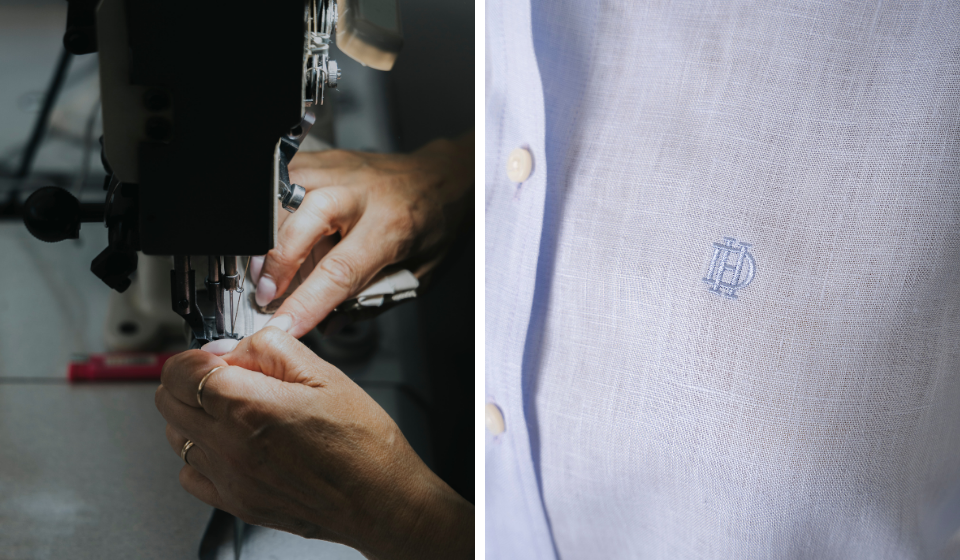
It starts with the raw material, because no construction can compensate for a weak fabric. Then comes the construction, which is where the company’s experience is most visible, even in things the consumer does not always see: the finishing, the way the garment behaves after washing, the strength of the seams and all the details that do not show up in a photograph.
And finally, there is durability as a design criterion. We make simple garments because we believe that simple pieces are the ones that will still be worn five years from now.
For us, premium is not a price, an adjective or a cliché. It is a standard. It means making a garment with the quality required for it to continue making sense many years from now.
Shirting is currently at the core of D’Heritage. Why did you choose the shirt as your starting point?
Because it is the garment we have made for fifty years. That is where our history and the know-how we inherited lie. Starting with something else would mean starting from the outside.
It is also the garment that most clearly exposes the people who make it. With a shirt, it is difficult to disguise a poor-quality fabric, an ill-resolved fit or rushed finishing. Anyone who knows the garment can see that quickly, often simply by touching the collar. Starting with shirts was also a way of forcing ourselves to get the most demanding part right before moving into other categories.
And there is another reason related to the kind of brand we want to be: a shirt does not belong to a season; it belongs in every wardrobe.
How far do you want to take D’Heritage in terms of product diversity?
The principle remains the same: we prefer a small number of very well-resolved pieces to an overly broad catalogue. Every new category has to answer a simple question: is this something someone buying D’Heritage really needs to have in their wardrobe? If the answer is no, we do not make it.
Our ambition is to progressively build an essential and complete wardrobe, with leather goods completing the range. We do not want to grow simply for the sake of growth.
For winter, I can give you an indication of the direction we are taking. We are working on heavier-weight cotton shirting designed for the colder months and exploring our first outerwear piece. It is the natural step for a company that has made shirts for fifty years: first, what we know how to do best; then, what completes the wardrobe beyond that.
To what extent is producing in Portugal now a strategic choice? What value does it add to the garment?
It is a strategic choice and, in our case, also the most natural one: D’Heritage was born “inside” a factory; it did not choose a factory after it existed. That origin shapes the way we work and the value we want to put into each garment.
Whenever there is a Portuguese alternative, that is the one we choose. All garment manufacturing, finishing, labels and packaging are carried out in Portugal, while the fibres that the country does not produce come from origins that we identify and declare for each garment. We also want the brand to be a way of showing that the Portuguese textile industry is still alive and that it is worth continuing to invest in it.
Keeping production in the same parish where our headquarters are located allows us to monitor every stage in real time: correct a detail on the same day, adjust a process without waiting weeks and ensure a level of quality control that would be impossible thousands of kilometres away. It also gives us the flexibility to work with short runs, without unsuitable minimum production quantities, and a shorter supply chain, with less transport and fewer intermediaries.
But producing in Portugal is worth more than proximity. The country, and particularly the North, brings together decades of accumulated expertise in spinning, weaving, dyeing and garment manufacturing, which translates into technical rigour, high-quality finishing and an industrial culture focused on durability rather than mass production. This is complemented by real investment in innovation, cleaner processes and energy efficiency, largely driven by the close relationship between companies and the sector’s technology centres.
There is also a human dimension that cannot be captured in metrics: here, the people who make the garments have a face, a name and a direct relationship with us. That, together with European environmental and labour standards and a short supply chain, also becomes part of the garment. It is part of its value.
How is your commitment to sustainability translated into concrete decisions about the product and processes?
I prefer to talk about concrete decisions rather than use the word sustainability in a generic way.
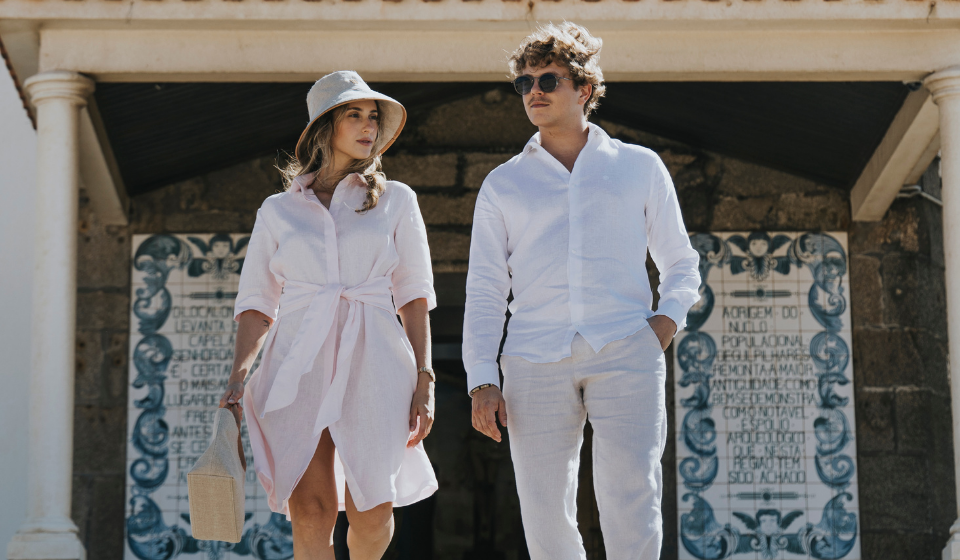
There are several concrete choices in that direction. For example, we work with linen, a fibre that requires relatively little water and few treatments. We also produce our leather goods to order, which allows us to avoid unnecessary stock.
There is another decision that is fundamental to us: making fewer garments, keeping them simpler and designing them to last. I consider a garment worn for five years to be more sustainable than five garments worn over the same period. For us, that is where a more responsible way of producing begins.
We are also working on traceability at garment level, so that the origin can be verified rather than simply claimed.
Is there any concern about the end of life of the garments? Are you considering a repair service?
Yes, and I prefer to speak about it honestly. We do not yet have a formal repair service, and I am not going to announce something as existing when we are still building it.
What we do today is handle things case by case whenever a customer contacts us. We can do this because we work very closely with several garment manufacturers, and that is an advantage most brands do not have: the people who make the garment can repair it.
We are now working to turn that capability into a process, with clear rules and a defined pathway for each garment. We are also looking for partners and sector associations that are already working in this area, because there is no point in solving alone something that can be solved better together.
In the meantime, there is one decision we have already made, and it comes before any repair service: whenever the function of the garment allows it, we develop it using a single material. A shirt that is 100% linen, or a T-shirt that is 100% cotton, is easier to repair and, at the end of its life, much easier to sort and recycle than a blend of fibres that no one can separate. With technical lines, this is not always possible because the garment has to meet performance requirements, but wherever it is possible, that is the path we follow.
A garment’s end of life starts to be considered when the fabric is chosen. That is where our work begins.
How do you want D’Heritage to be recognised?
As a brand with history, but above all for what we say and what can be verified.
We do not want people simply to believe what we say about the origin of the garments or the materials. We want it to be possible to verify where a garment was made, what fabric it uses and its fabric weight. That is why we are working on garment traceability.
If, in a few years’ time, D’Heritage is recognised as a brand where what is written on the label corresponds exactly to what is in the garment, we will have achieved our goal.
Is there already a defined vision for the brand in the medium term?
We want to be a Portuguese brand recognised for making a limited range of garments extremely well, with production in Portugal and a presence in selected stores, both in Portugal and abroad.
In practice, that means three things: consolidating shirting, building a physical distribution network through multi-brand stores, and keeping production where it is, creating the capacity to grow without having to move to another country.
Will the distribution strategy be essentially digital, or are you looking for multi-brand partners and physical points of sale?
Both, but with different roles.
Digital is where we can explain the brand: the story, the materials, the origin and what justifies the price. The physical store is where the garment is decided. Any fibre and any construction take on another dimension when they can be touched and tried on.
That is why we are building a short, carefully selected network of multi-brand stores.
We are not looking to be everywhere. We are looking to be in the right places.
How are you approaching internationalisation? Is it a priority from the outset or will it be a second phase?
It will be a second phase, but we have been preparing for it since day one.
Consolidating in Portugal first is a matter of discipline, not a lack of ambition. A brand has to prove its value in the market where it was born before trying to do so in other markets.
At the same time, we know that the domestic market alone will not be enough to sustain a brand in the long term. That is why, in parallel, we are preparing materials, technical sheets, compliance requirements and a possible presence at international trade fairs.
Which are the main markets you have identified as priorities, and why?
Spain will be the first international market we want to work on, for three simple reasons: logistical proximity, the value placed on Portuguese origins in the textile sector, and the existence of a network of multi-brand agents capable of working across the Iberian Peninsula.
After that, we are looking at other European markets where Portuguese production already has a strong reputation and where proximity compared with Asian production may carry increasing weight in purchasing decisions.
What are the objectives you have set for D’Heritage’s first year?
We have three priorities.
The first is to prove the brand. And proving it does not mean selling one garment; it means selling a second one to the same person. That is when you find out whether the garment delivered on its promise, and it is the indicator I trust most in this first year.
The second is to have a physical presence. A shirt convinces through touch, and a screen cannot convey touch. We want to be present in a limited number of multi-brand stores and hold some of our own events, where people can pick up the garment, look inside it and feel the weight of the fabric. That is where our story can be explained in thirty seconds and almost without words.
The third is the winter collection, with essentials designed for the colder months and our first outerwear piece, without losing the standard we defined from the beginning. The temptation to expand quickly is always there, and that is precisely where brands that start well can lose their way.
And then there is an objective that underpins the other three: a balanced operation, with a healthy cost structure and our partner manufacturers working consistently. After what happened in 2024, that is the primary objective.
What size would you like D’Heritage to reach in three or five years? What chapter would you like to write in this family story?
In terms of scale, we want our manufacturing partners to have enough stability to secure contracts and grow their teams, a physical presence in Portugal and Spain, and a limited but very well-resolved range. We are not aiming for volume. We are aiming for consistency. And that is considerably harder.
As for the chapter, there is one part of this story that has a particular meaning for me. My grandfather made clothes for fifty years, and much of that clothing left that door bearing the names of other brands. He died in 2022 without his own label ever reaching a shop window, and the company closed two years later.
The chapter I want to write is this one: bringing his textile legacy back to life, now through the hands of his son and grandson. And, if possible, along the way, working with other companies that have gone through the same experience and that, like us, refuse to give up on a sector that remains one of the great engines of our economy.
If, five years from now, that is simply a normal fact rather than a novelty, we will have succeeded.